



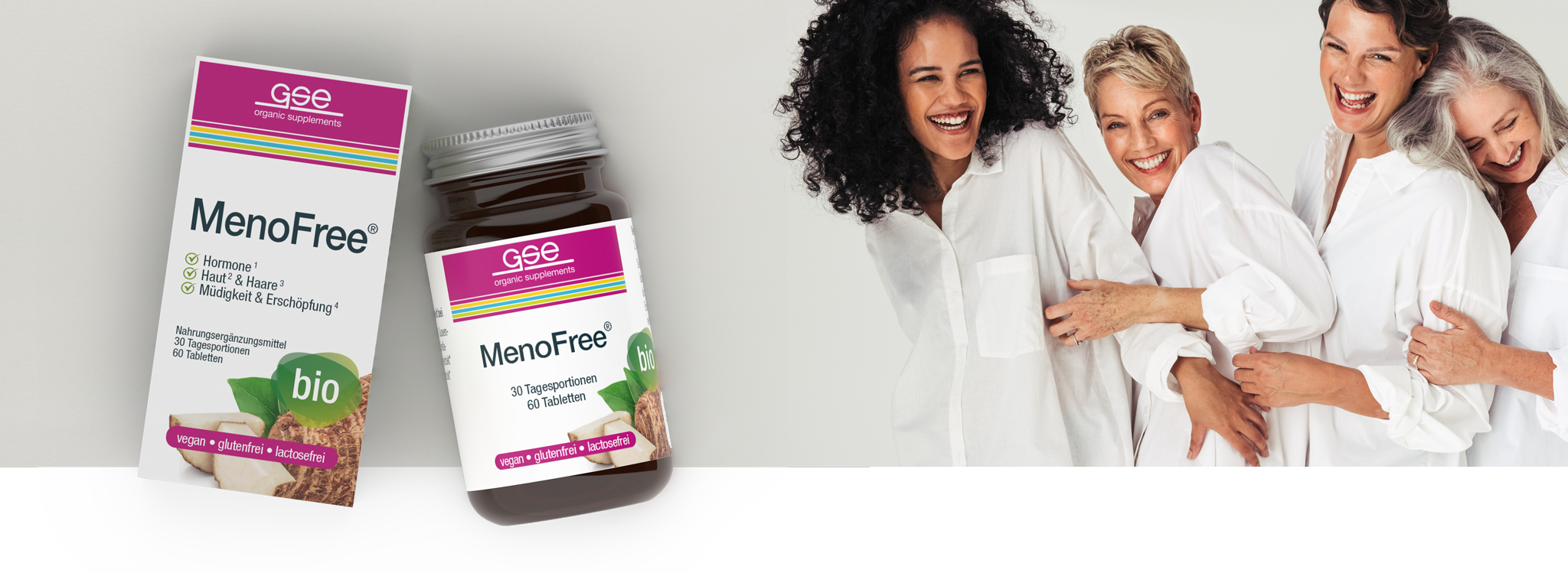
MenoFree®: Naturally Harmonious Through Menopause
Food supplement with yam root and B vitamins from organic plant extracts
Menopause – A Time of Change
Menopause refers to the very last menstrual period in a woman's life. The technical term for the phase before and after this milestone (i.e., the actual climacteric) is climacterium. Nevertheless, "menopause" has become an established synonym for climacterium. Perhaps because it sounds nicer? In any case, menopause ushers in a new phase of life for women. As the fertile phase slowly comes to an end, not only does the female body change; personal feelings are also in flux. Usually around the age of 45, the hormonal balance begins to change inexorably. From the so-called pre-menopause into the perimenopause, the ovaries produce fewer and fewer sex hormones, periods become irregular and eventually stop altogether.
The Climacteric Lives Up to Its Name
Just as varied as women's hormone levels are in the first half of their lives, so too are their individual experiences of menopause. Some women clearly feel the drop in estrogen levels and the associated changes, while others hardly notice them. A mindful lifestyle with a conscious diet, sufficient exercise, and good stress management can have a positive effect on physical and psychological well-being during this challenging time. Making targeted adjustments here is definitely worthwhile!
In terms of diet, B vitamins are particularly important, and some plant-based substances also offer support. If the daily diet does not reflect the increased need for essential nutrients, a good dietary supplement can be beneficial. For example, vitamin B6 contributes to the regulation of normal hormonal activity, while vitamin B5 supports the synthesis and metabolism of steroid hormones (e.g., estrogen). Vitamins B1, B6, B12, biotin, and folic acid contribute to normal psychological function, vitamins B5 and B6 to normal mental performance and nervous system function, respectively. Vitamins B5 and B6 can help to reduce tiredness and fatigue. Vitamins B2 and biotin are also known for their contribution to the maintenance of normal skin and mucous membranes, with biotin known as the "hair vitamin."
Plant-based Freedom with Yam Root and B Vitamins
MenoFree® is a purely plant-based dietary supplement for women in menopause. It combines a powder from the yam root Dioscorea villosa with natural B vitamins from guava fruits, spirulina and chlorella algae, yeast extract, mango fruits, adzuki beans, lemon peel, and basil. It deliberately avoids synthetic additives. All plants and fruits used for MenoFree® come from strictly controlled organic cultivation. The product is gluten-free, lactose-free, and vegan. The high-quality brown glass packaging optimally protects the valuable ingredients.



-
- Vitamin B6 contributes to the regulation of hormonal activity
- Vitamin B5 supports the synthesis and metabolism of steroid hormones (e.g. estrogen)
-
- Vitamin B2 and biotin contribute to the maintenance of normal skin and mucous membranes
-
- Biotin contributes to the maintenance of normal hair
-
- Vitamins B2, B6 and B12 contribute to normal energy metabolism and to the reduction of tiredness and fatigue
-
- Vitamins B1, B6, B12, biotin and folic acid contribute to normal psychological function
- Vitamin B5 contributes to normal mental performance. Vitamins B6 and B12 contribute to the normal functioning of the nervous system
EFSA* Health Claims for the nutrients contained in MenoFree®:
- Vitamin B6 contributes to the regulation of hormonal activity
- Vitamin B5 contributes to normal synthesis and metabolism of steroid hormones (e.g. estrogen), to the reduction of tiredness and fatigue, normal energy metabolism and normal mental performance
- Vitamin B2 and Biotin contribute to the maintenance of normal skin and mucous membranes
- Biotin contributes to the maintenance of normal hair
- Vitamin B2, B6 and B12 contribute to the reduction of tiredness and fatigue, normal energy metabolism and normal functioning of the nervous system
- Vitamin B1, B6, B12, Biotin and Folic Acid contribute to normal psychological function
*EFSA = European Food Safety Authority

Menopause, climacteric, premenopause, perimenopause, menopause, postmenopause: When is what?
-
The term menopause refers to the entire period during which a woman's hormone balance adjusts from "fertile" to "no longer fertile". The technical term for menopause is climacteric. Often, "menopause" is incorrectly used as a synonym instead, but this term correctly refers to a completely different milestone (see Menopause).
-
First changes in hormone balance, usually around the age of 40. The production of the sex hormones estrogen and progesterone slows down somewhat, while more follicle-stimulating hormone (FSH) is produced. Sometimes the cycle becomes irregular now, or initial PMS-like symptoms such as irritability or water retention become noticeable. If the ovaries stop working already in this phase or even earlier, this is called premature menopause or climacterium praecox.
-
The premenopause is followed directly by the so-called perimenopause, predominantly between the ages of 45 and 55. Fewer and fewer eggs, estrogen, and progesterone are produced, which can significantly disrupt the hormonal system. Cycles can therefore be either longer or shorter, and bleeding can be both lighter and heavier. Some women also experience typical menopausal symptoms such as hot flashes, sleep disturbances, depressive moods, or decreased libido.
-
Only the very last menstrual period in a woman's life is correctly called menopause. On average, this occurs around the age of 52. The woman no longer ovulates, and conception is highly unlikely. However, follicle-stimulating hormone (FSH) continues to be produced.
-
If a woman's very last menstrual period was more than a year ago, the so-called postmenopause begins. Bleeding is a thing of the past. With a bit of luck, menopausal symptoms may subside; however, other discomforts such as dry skin and mucous membranes, joint pain, or increased facial hair growth may also occur. It is important to pay close attention to bone nutrition during this time, as the lack of estrogen makes them more brittle and the risk of osteoporosis increases. Supplements with calcium, vitamin D3, vitamin K, magnesium, and iodine can make an important contribution to this. Only when the hormonal "remodeling" is completely finished at around 60–65 years of age are the menopause over and the so-called senium (old age) begins.